Specification for an Art Exhibit
Last updated: 1/17/2026 | Originally published: 1/17/2026
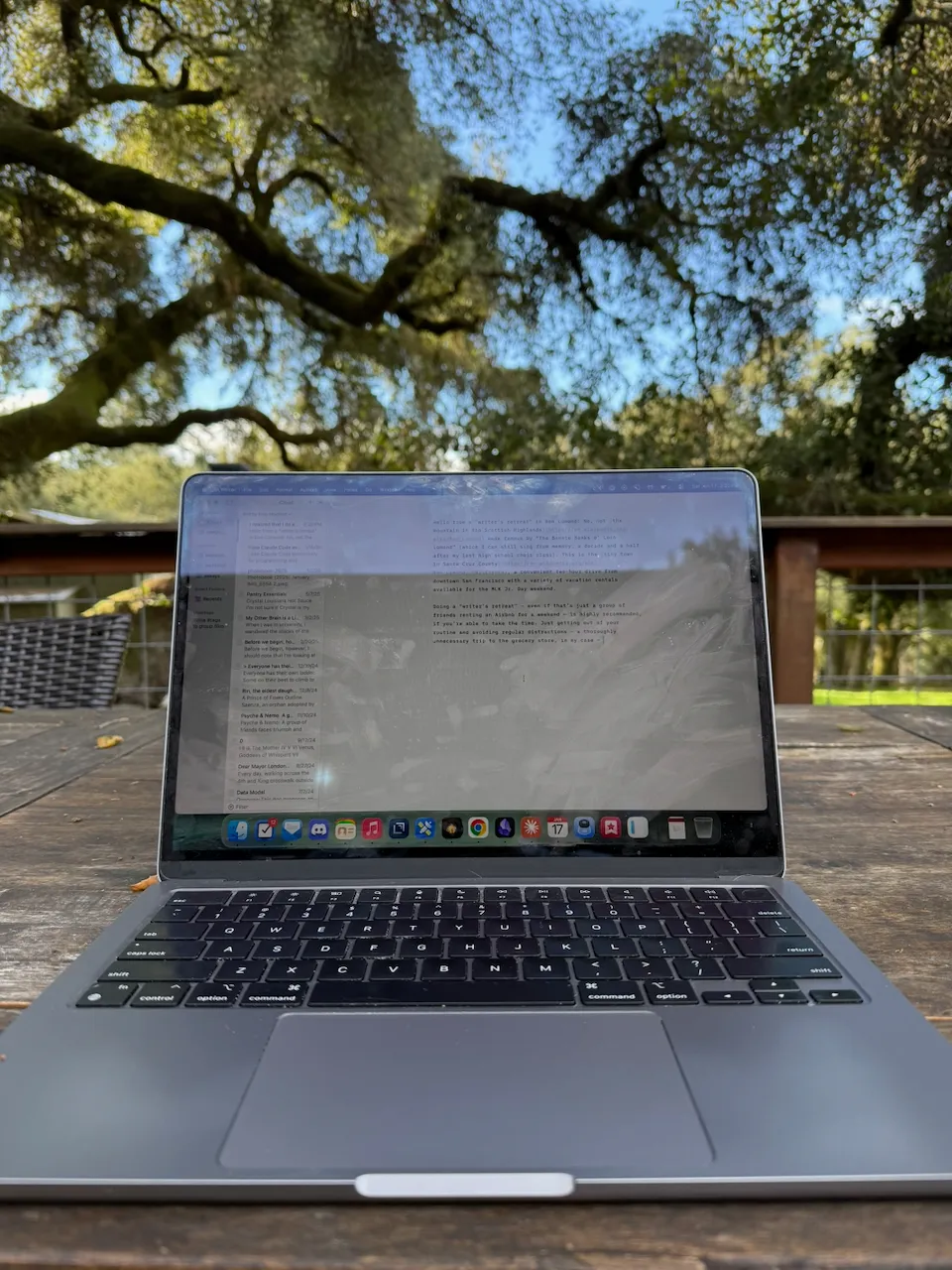
Hello from a “writer’s retreat” in Ben Lomond! No, not the mountain in the Scottish Highlands made famous by “The Bonnie Banks o’ Loch Lomond” (which I can still sing from memory, a decade and a half after my last high school choir class). This is the tiny town in Santa Cruz County, a convenient two-hour drive from downtown San Francisco with a variety of vacation rentals available for the MLK Jr. Day weekend.
Doing a “writer’s retreat” — even if that’s just a group of friends renting an Airbnb for a weekend — is highly recommended, if you’re able to take the time. Just getting out of your routine and avoiding regular distractions — thoroughly unnecessary trips to the grocery store, in my case — is surprisingly productive.
Here’s a specification for an art piece I thought up once:
The piece should be placed in a warehouse — large enough to not be human scale, but small enough to not be completely overwhelming. The piece itself is a “forest” of lights — a mismatched combination of street lamps and household lamps (and possibly others, as long as they’re about 5-7 feet tall — near or just above head height) placed in a grid, with 5-foot spacing between them. They’re all wired together with dimmable bulbs, such that a software program can control the light level on each individual light. Viewers walk through the “forest” as various light patterns play out through the “trees” of light — waves of light and darkness, or all lights suddenly turning on or off all at one, or light “racing” through the forest like fairies. Perhaps there’s a viewing platform to see the patterns from above, or perhaps you can only experience it by walking through it.
I’m not a conceptual artist — I’m a writer; I’m not used to having to do anything more than open my laptop to get creative work done; where would I get the warehouse and hundreds of lights, let alone programming them? — but if I was, I’d be pursuing this. But maybe someone reading this will be inspired? 😉
As happens at least once a month, I miss writing linkblogs. Maybe I’ll start a mini-newsletter just for reading recommendations, or include it as a regular section in my weekly newsletters. But, in the meantime, here’s a few things I saw this week that I would like to pass along:
- The 2025 Satyrs’ Forest Horny Awards™: One of the wildest and loveliest websites on the weird wide web, the Satyr’s Forest is always a delight, and particularly their year-end media review. This year, they added extremely charming spinnable DVDs for each movie they review. And they turned me on to Ninajirachi’s I Love My Computer, which is a.) the most Zillennial album ever b.) almost definitely going to be my album of the year 2026.
- “This Is How You Get JARHEAD Sequels”, Folding Ideas: Despite watching them somewhat often, I’m not a fan of Modern YouTube Video Essays, because they often have lengthy runtimes without saying all that much. Folding Ideas is one of the better video essayists, and this video is worth the investment — an analysis of why Jarhead is great, why its “sequels” are so very, very bad, and why those sequels were even made (hint: film industry finance). Though, I would still perhaps recommend 1.5x speed.
- “The Wisconsin Town Ruled By A Pseudo-Catholic Cult”, Tor’s Cabinet of Curiosities: Self-described “autistic special interests” channel Tor’s also makes lengthy videos — this one is 98 minutes, so I would recommend 2x speed… — but they’re so consistently fascinating that I end up watching all of them. This one is about the history of the Necedah Shrine, a pseudo-Catholic, Marian cult started in the ‘50s that ended up dominating the small town of Necedah, Wisconsin and hosting an assortment of bizarre Catholic-adjacent cult figures. Though, I may find this episode particularly interesting because as a Midwestern child I spent a lot of time in Wisconsin Dells, which is only a half hour drive from Necedah, so it’s conceivable I’ve passed through the town in the past. General audiences may prefer this 38-minute video about the history of Jagganath that inspired the English term “juggernaut”.
- “Modern Pagan Witchcraft”, Ronald Hutton: I’ve been meaning to read Hutton’s celebrated Triumph of the Moon, on the history of Wicca, for probably close to a decade, and now I don’t have to, because he’s condensed it into a 45-minute lecture! (But I probably still will read it… someday…)