Completely Unknown To Even Well-Read Americans
Last updated: 8/2/2026 | Originally published: 8/2/2026
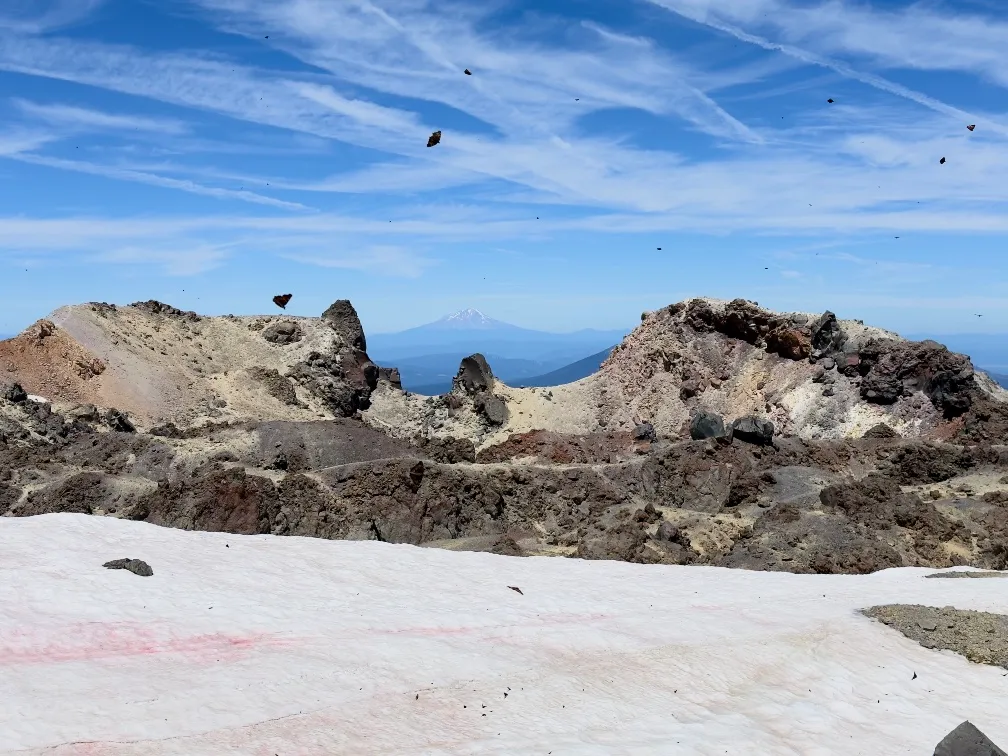
Hello hello once again. This weekend I ascended Lassen Peak — a surprisingly easy four-hour roundtrip, certainly no worse than Vancouver’s awful Grouse Grind — and was rewarded with a lovely view of Mount Shasta, a bit of snow, and a magical number of butterflies.
Also, I was dragged to Applebee’s twice. The perils of traveling with Canadians…
This week I want to talk about a slightly unusual recommendation that I recently revisited: The Assault by the Dutch author Harry Mulisch. Unusual because, as Nate Meyvis once noted, Dutch (literary) fiction is basically a black hole in Anglophone culture. Dutch artists are extremely well known, and other European fiction in translation is broadly popular.1 I’d wager most literary-minded Americans that have been in a book shop recently are at least vaguely aware of Annie Ernaux and Olga Tokarczuk, both of whom are recent Nobel winners. But Dutch fiction has exerted, seemingly, no influence on Anglophone culture, and most Dutch authors are completely unknown to even well-read Americans. Quite strange!
For my part, I’m only familiar with The Assault because I happened to move to Germany in high school, and I happened to have an English lit professor at the international school I happened to go to who happened to be married to a Dutch man and so happened to assign The Assault in class. She also had her husband come into class to talk to us about Mulisch, who was (according to her husband) arguably the most famous postwar Dutch novelist, a perennial choice for Nobel bettors, the kind of author assigned to pretty much every Dutch high school student, like the Dutch equivalent of John Steinbeck or something.
So, an important book, but not something most Americans would probably encounter. But it’s really worth reading!
The plot opens with the eponymous assault: a normal Dutch family, including the main character Anton, then a grade schooler, is just trying to survive the last days of the German occupation during World War II. Then a notorious collaborator is shot in front of their neighbor’s house, but the neighbors move him in front of Anton’s house. The Germans show up, Anton’s house is burned down, and in the chaos Anton is separated from his parents. After a (surprisingly funny) set of handoffs from Gestapo officer to ortskommandantur to Wehrmacht general, all of whom are a little confused how he ended up there, he winds up at his uncles and finds out that his parents have been shot.
Then the rest of the novel is about how he deals with those memories, or, more precisely, doesn’t.
It’s pretty easy to see why The Assault is assigned to high schoolers. It has a lot of Big, Obvious Motifs that teachers can make students write essays on. For example, young Anton — who rapidly forgets the exact details of that horrible night — eventually becomes an anesthesiologist, developing an unusual theory that anesthetized patients still feel pain but just forget about it — which is, of course, the exact situation he’s in. Or there’s his fascination with antique — literally, stopped — clocks, or the scene where he ends up with a terrible toothache and has to treat it with the old-timey remedy of a piece of clove between the teeth — not realizing that was exactly what his mother was doing the night she was killed.
The first time I read The Assault, as a high schooler, I found that pretty off-putting — exactly the kind of “symbol hunting” that bad English classes sometimes encourage. But when I reread it a few years later, and even more so when I just reread it, I was astounded by how naturally Mulisch weaves the themes, motifs, and plot together.
So, for instance, the book opens with a prologue describing Anton’s idyllic pre-war childhood, which is, of course, a great way to underline the horror of the following wartime chapter. But the chapter goes out of its way to end with a description of how he liked to watch motorboats go by on the water near his house, leaving complex patterns of waves in their wake. But then the prologue ends:
Each time, Anton tried to figure out how exactly this happened, but each time the pattern became so complex that he could no longer follow it.
… which is, of course, the main theme of the novel: how one act of violence is informed by everything that came before it, and how that act of violence echoes out to everything that comes after, in a complex web of interaction that no one can ever fully understand.
Which, of course, reminds me of one of my other favorites, Watchmen,2 Which, you may recall, I mentioned a couple weeks ago — that mention may have inspired this reread of The Assault actually. which is similar both thematically and in its mastery of coherence.
Part of what makes this so impressive is that The Assault doesn’t waste any time — it’s barely 185 pages in translation, readable in a day or two, even though it covers literally the entirety of Anton’s life. While it has a lot of tangential content and, for a lack of a better term, “literariness,” it’s also a straightforward detective story, as Anton (mostly by accident) uncovers the truth about what happened that night. That lends the novel a propulsive quality that’s frankly pretty rare outside of genre fiction.
But the real reason I love this novel really is all those tangential one-off sentences and paragraphs, many of which have burrowed deep into my brain.
As an example, there’s one paragraph that explains that Anton shares a name with the leader of the Dutch fascist party — so Anton knows that anybody named Anton or Adolf born during the war is the child of collaborators. But then, as an aside, the narrator points out that World War II will only truly be over3 Which is, yet again, underlining the main theme of the novel! when Dutch parents feel free to name their children Anton and Adolf again — a comment I think of pretty much any time WWII-related media comes up.
A word on the translation: there is, as far as I can tell, only one English translation, by Claire Nicolas White, published by Pantheon. Unfortunately, even though I love the novel, I can’t quite recommend the translation unreservedly — most of the English word choice feels not-quite-idiomatic, and (according to my teacher’s Dutch husband4 Who, being fluent in both languages, was decidedly unimpressed with the translation. ) the translation gets a lot of the smaller details wrong. So, that’s unfortunate — but the novel is strong enough to survive (mis)translation.